


Interdisciplinary Dialogue: The Key to Humanising AI


 ×
×
×
×
×
Interdisciplinary Dialogue: The Key to Humanising AI
An article by Francesco Chiavarini
Artificial intelligence is no longer merely a technological innovation. It is an anthropological, educational, political, economic and even spiritual issue. It must therefore be approached from multiple perspectives. This is the vision at the heart of “Humane Artificial Intelligence. From Foundations to Applications and Policy Frameworks”, a collection of essays published by Vita e Pensiero and edited by Giuseppe Riva, Professor of General Psychology and Director of the Humane Technology Lab at Università Cattolica del Sacro Cuore, and Massimo Chiriatti, Chief Technology & Innovation Officer at Lenovo Italy and lecturer at Università Cattolica and Luiss. Bringing together contributions from academics teaching across different disciplines at the University, the volume seeks to foster dialogue between different fields of knowledge.
The potential of this approach became clear during the conference presenting the book, held on Thursday, 14 May, at the University's new campus in Milan.
Following opening remarks by Rector Elena Beccalli, who emphasised the need for an “alliance between disciplines” and also between universities, philosophers, neuroscientists, psychologists, economists, legal scholars, statisticians and computer scientists from Università Cattolica came together for an afternoon of discussion around a shared question: how can we prevent the genius released from the computer engineers' lamp, while granting our wishes, from also fulfilling our worst desires – or even developing its own?
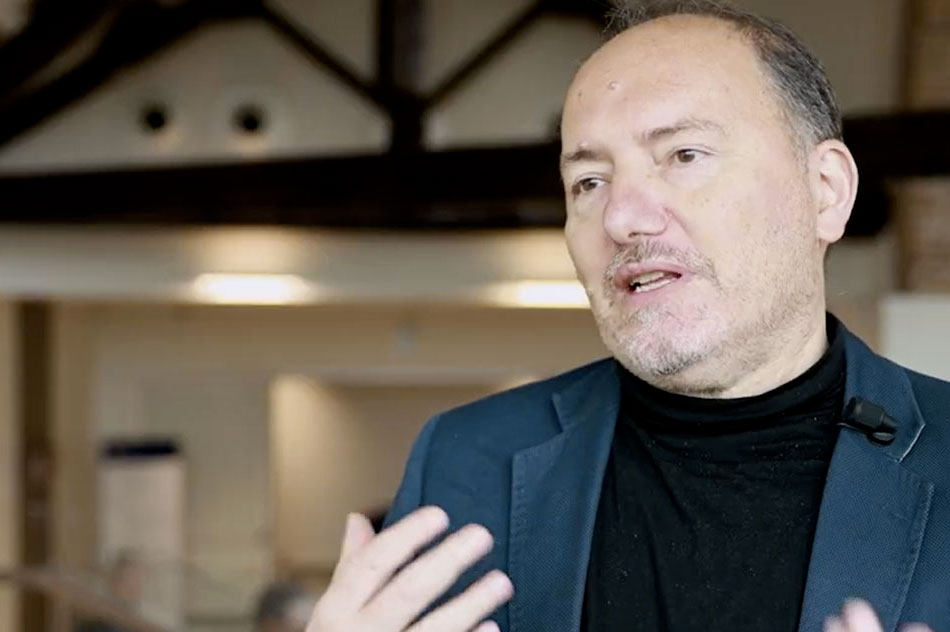
At the heart of the discussion was the keynote speech delivered by Mario De Caro, holder of the UNESCO Chair in Ethics of AI and Practical Wisdom at Roma Tre University and Visiting Professor at Tufts University in Boston, who engaged in dialogue with the book's contributors.
According to the philosopher, AI systems are acquiring increasing levels of autonomy and unpredictability, making explainability – the ability to understand how machines make decisions – an increasingly urgent issue. It is not enough, he argued, to restrict the most dangerous uses of AI: we must “embed ethical principles directly into the design of algorithms”, following the principle of ethical by design. In other words, it would be better to educate the Genie before letting it out of the lamp than to try to repair the damage afterwards.
Yet this is far from an easy challenge to resolve, as Alessandro Giordani, Professor of Logic and Philosophy of Science, observed during the first roundtable, devoted to the foundations of human-AI relationships. We must also question the very foundations of the moral frameworks on which we intend to model artificial intelligence systems. And we may not all agree on the validity of many principles that seem self-evident to us.
Are such concerns exaggerated? Antonella Marchetti, Head of the Department of Psychology, cautioned against excessive alarmism. In her view, many of our fears are simply a reaction to the “narcissistic wound” caused by this innovation. We would do better to “accept that human beings are no longer at the centre of intelligence”, just as we have accepted that we are no longer at the centre of the universe (after Copernicus), of evolution (after Darwin) or even of our own psyche (after Freud). We should instead “establish a relationship of trust with the machines” we have created in order to “evolve alongside them”. Human-machine interaction is already proving beneficial in many cases, she noted, citing improvements in relational and socio-cognitive abilities that interaction with AI can offer to people on the autism spectrum and older adults with neurodegenerative conditions.
That algorithms are evolving, and doing so rapidly, is clear to Luca Mari, Professor of Electrical and Electronic Measurements, who outlined three stages. The first two – programmed-behaviour machines and learning machines – are already behind us. We have now entered a third stage, that of “agency”, in which AI systems are no longer simple tools that execute instructions, but agents capable of taking initiative.
The key to this technological evolution, explained Guido Consonni, Professor of Statistics, lies in the introduction of causal relationships, which makes it possible to move beyond the training phase, during which models learn from their mistakes.
Will machines therefore become capable of inventing as well? Andrea Gaggioli, Director of the PsiCom Research Centre, appeared rather sceptical on this point. Devices themselves, he argued, will never be creative. Rather, creativity will emerge from “the system that human beings develop together with them”, through an increasingly close relationship that may one day even become “symbiotic”.
One field in which human-machine interaction has already achieved remarkable results is gaming. In video games, AI creates stories, composes music, generates images and manages relationships between players and avatars. However, as Daniele Toti, Professor of Computer Science, pointed out, when “artificial intervention takes over human creativity, users generally notice and reject it”. Perhaps that is not such bad news.
But if machines are changing, and doing so rapidly, how are the people who use them changing?
Michela Balconi, Professor of Cognitive Neuroscience and Director of the IrcCAN Research Centre, illustrated the effects of widespread AI use on cognitive functions. Hyperscanning studies, which analyse the simultaneous brain activity of multiple individuals during an interaction, point to an ambivalent picture: on the one hand, they appear to indicate an enhancement of mental abilities; on the other, they reveal new forms of vulnerability.
Meanwhile, artificial intelligence has already entered the workplace. Ivana Pais, Professor of Economic Sociology, presented the initial findings of the CNEL Observatory on AI adoption. The research, she explained, shows that artificial intelligence has already become a subject of negotiation between employees and employers, sometimes involving significant conflict. What is most surprising, she noted, “is that none of the contracts analysed makes any reference to the environmental impact of this technology, which, as we know, requires enormous amounts of energy to operate”.
At the same time, the pace of innovation continually outstrips the ability of workplaces to adapt, creating what Stefano Gatti, Head of Data & Analytics at Nexi, described as a “chronic training debt”.
The final roundtable addressed the legal and political implications of artificial intelligence, a field that presents its own set of challenges.
According to Barbara Boschetti, Professor of Administrative Law, there is a risk of a laissez-faire drift which, by progressively weakening regulation, could erode the very foundations of our democracy. Gabriele Della Morte, Professor of International Law, focused instead on the disorientation brought about by the digital world: “Law originates within a defined geographical and temporal space, whereas the digital world dissolves proximity and temporal succession.” This makes it difficult to establish rules for phenomena that are global, intangible and extremely fast-moving. According to Della Morte, one possible solution would be to distinguish between hardware, software and data, developing “differentiated but integrated regulatory systems”.
The afternoon concluded with Roberto Moro Visconti, Professor of Corporate Finance, who addressed the impact of artificial intelligence on teaching within the University. “AI is easy to use, fast, and always tells you that you are right; but real life also involves conflict. We would be failing in our duty as teachers if we did not remind you of that,” he observed, addressing the students.
And perhaps coming to terms with conflict, rather than trying to eliminate it, is also the key to addressing the ambiguities of these tools onto which, ultimately, we continue to project ourselves.
The article was originally published on Secondo Tempo.
Read more


