


Humane Artificial Intelligence
Humane Artificial Intelligence
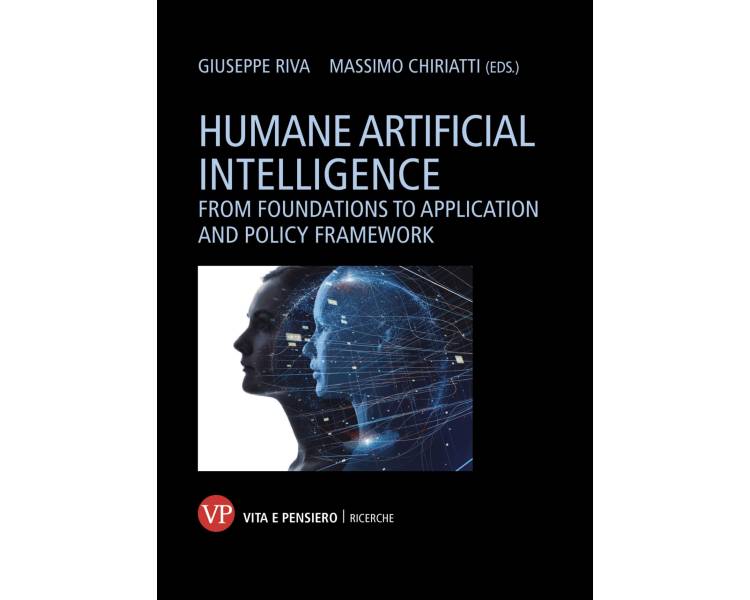
Humane Artificial Intelligence: the New HTLab Volume Published (December 2025)
Published in December 2025 by Vita e Pensiero, Humane Artificial Intelligence is a new interdisciplinary volume edited by Giuseppe Riva and Massimo Chiriatti. The book brings together contributions from faculty members and researchers of Università Cattolica del Sacro Cuore, alongside internationally renowned scholars and professionals, with the aim of fostering a critical reflection on artificial intelligence that places the human person, well-being, and ethical values at its core.
The volume is part of the research and scholarly activities promoted by the Humane Technology Lab (HTLab) at Università Cattolica del Sacro Cuore. It proposes a paradigm shift from traditional AI approaches—often focused primarily on efficiency and optimization—toward a vision of AI that foregrounds ethical principles, transparency, human autonomy, and individual well-being. Humane Artificial Intelligence introduces and consolidates the emerging field of “humane AI,” emphasizing the crucial role of interdisciplinarity in designing technologies that genuinely serve human flourishing.
The book also represents the latest installment in the editorial trilogy promoted by HTLab, following Humane Robotics (2022) and Humane Metaverse (2024).
The Preface by Rector Elena Beccalli
The volume opens with a Preface by Rector Elena Beccalli, who situates the topic of artificial intelligence within the educational and cultural mission of Università Cattolica del Sacro Cuore. The Rector recalls the idea of a university “for the world,” committed to serving society by integrating technological innovation, social responsibility, and the integral formation of the person. In this perspective, AI emerges as a crucial challenge for education, research, and equity—one that requires a broad vision and genuinely interdisciplinary dialogue.
Contents of the Volume
In the introductory chapter, Giuseppe Riva and Massimo Chiriatti outline the emerging field of Humane Artificial Intelligence, highlighting the need to move beyond purely efficiency-driven and optimization-centered approaches. For AI to be truly “humane,” it must integrate ethical principles, transparency, and sustained attention to human well-being.
The volume is structured around four main thematic areas:
- Theoretical and philosophical foundations of human–AI relationships, ranging from models of cognitive extension to debates on meaning, intentionality, and machine agency;
- Creativity, cognition, and human enhancement, exploring when human–AI collaborations are most effective and addressing questions related to artificial consciousness and well-being;
- Professional applications, with a focus on work, mental health, and diagnostic contexts, where the adoption of AI requires a careful balance between automation and human expertise;
- Legal and regulatory frameworks, examining both ambitious normative visions and the concrete challenges of governing rapidly evolving technologies.
Taken together, the contributions demonstrate that only an interdisciplinary approach can foster technologies that respect human autonomy, enhance human capabilities, and promote authentic human flourishing.
The Afterword by Paolo Benanti: Algor-ethics for a New Humanism
The volume concludes with an Afterword by Father Paolo Benanti, a Franciscan friar and Professor of Ethics of Technology at Luiss University, internationally recognized for introducing the concept of Algor-ethics. An advisor to the Holy See and the Italian Government on artificial intelligence, Benanti offers a profound reflection on the anthropological nature of AI, interpreted as a true Machina sapiens.
His analysis highlights the historical discontinuity represented by artificial intelligence and the need to distinguish between innovation and development. Only an ethics that can also be translated into computational language, he argues, can ensure that technologies remain tools at the service of human beings rather than substitutes for them. Algor-ethics thus emerges as a bridge between human values and machine logic, essential for preventing technocratic drifts and promoting responsible AI governance.
The Editors
Giuseppe Riva is Professor of General Psychology and Director of the Humane Technology Lab at Università Cattolica del Sacro Cuore. He is internationally recognized as a leading scholar in human–technology interaction and human-centered technologies.
Massimo Chiriatti is a distinguished technology leader, author, and academic with over thirty-five years of experience at the forefront of digital innovation. He is currently Chief Technology and Innovation Officer at Lenovo Italy and Adjunct Professor at Università Cattolica del Sacro Cuore.
Open Access Ebook
The volume is available in print and as an open access digital edition on the Vita e Pensiero website.
